The Charleston Dance Everyone Thinks They Know
Any of us who dance swing love the Charleston dance — but how many truly know its history?
When people picture the Charleston, they often imagine glamorous white flapper girls, cigarette holders in hand, dancing with high-energy kicks on screen.
But who actually created the Charleston dance?
Where did the first steps come from?
Why are there so few surviving images of Black Charleston dancers?
The real story is far richer — and it begins long before the 1920s. Let’s dive into the real Charleston dance history:
What Are the Origins of the Charleston Dance?
The Charleston dance belongs to the family of African American vernacular dances. More specifically, it is an authentic jazz dance, originally performed to ragtime and hot jazz. Its movements combine African-derived dance traditions with syncopated jazz rhythms.
1800s – Juba Dance: The Early Root of Charleston
Did the Charleston dance come from Africa?
Yes — enslaved Africans from the Kongo region brought a dance known as the Juba dance (or Djouba) to Charleston, South Carolina. Europeans later adapted and renamed it.
The Juba, or hambone, was an African American style involving stamping, patting the chest and arms, clapping, and intricate footwork. It arrived in Charleston between 1735 and 1740, evolving over generations.
Even in the 18th century, the Juba was so popular that households prized Black domestic workers who could teach their employers a few steps.
“Enslaved Africans brought it (The Charleston dance) from Kongo to Charleston, South Carolina, as the Juba dance, which then slowly evolved into what is now known as Charleston. (…) In Africa, however, the dance is called Juba or the Djouba. The name Charleston was given to the Juba dance by Europeans much later when they came to America.”
— Africanisms in American Culture, p.52
🎥 Watch an example of the Juba dance here on YouTube.
The Gullah/Geechee Steps and Culture Behind the Charleston
Many historians connect the Charleston dance to Gullah culture — descendants of West African rice-growing tribes, enslaved and brought to the sea islands of South Carolina, Georgia, and Florida.
Music and dance were inseparable in Gullah culture. Unique rhythms and dance rituals were absorbed by Charleston’s early jazz and ragtime musicians.
According to Frankie Manning, from the book “Ambassador of Lindy Hop”, the Charleston may have been based on a step called Jay – Bird, and is said to have originated in South Carolina, Charleston, where it was sighted in 1903.
The Jenkins Orphanage Band: Spreading the Charleston
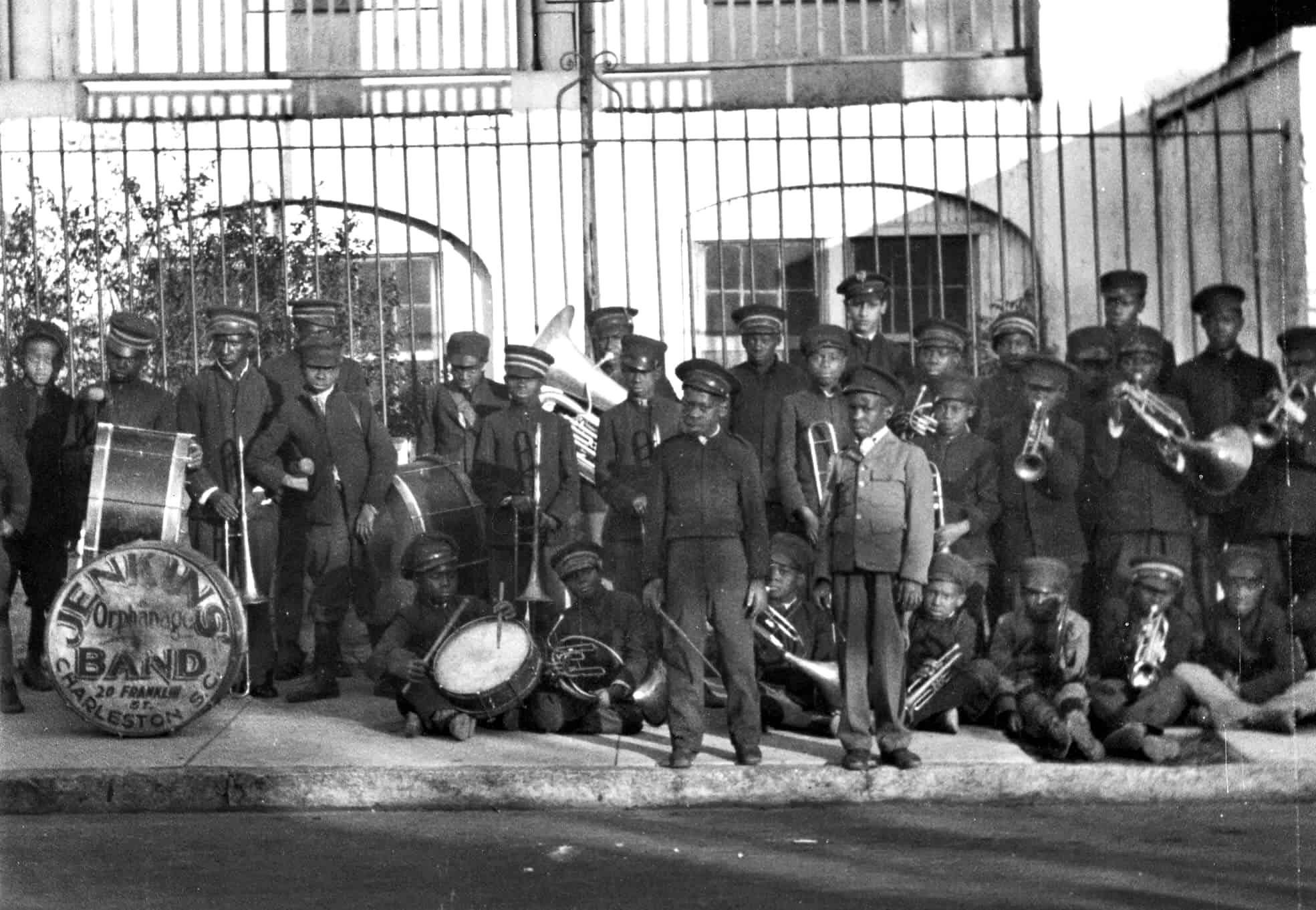
In 1891, Reverend Daniel Jenkins founded an orphanage for African American children in Charleston, South Carolina. To raise funds, he created a brass band — the Jenkins Orphanage Band.
The band performed Gullah (or Geechee) music, often with young dancers in front, performing “geechie” steps as if conducting the musicians.
Many scholars believe this band is responsible for spreading Charleston dance steps nationwide as they toured.
Who Invented the Charleston Step? Competing Stories
Story I — Boys from the Jenkins Band
In Steppin’ on the Blues, Professor Jacqui Malone recounts how street and cabaret dancer Russel Brown was known for the “Geechie dance” — later called The Charleston.
Jazz pianist Willie “The Lion” Smith remembered:
“People in Harlem would holler when they’d see Russel Brown dance: ‘Hey Charleston, do your Geechie dance.’”
Smith argued the dance had been in New York for years before Brown arrived, spread by the Jenkins Orphanage Band boys.
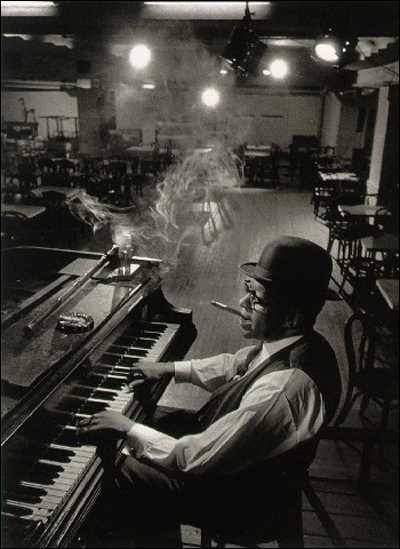
Willie Smith recollects that people in Harlem would holler when they’d see Russel Brown dance: “Hey Charleston, do your Geechie dance”.
Some folks say that is how the Charleston got its name. I am a tough man for facts and I say the Geechie dance had been in New York for many years before Brown showed up. The kids from the Jenkins Orphanage Band in Charleston used to do Geechie steps when they were in New York on their yearly tour
Willie Smith (Steppin’ on the Blues, p.85)
It is interesting to mention that Gullah is the most authentic African culture in America. In the Gullah culture, music was not separated from the dance it accompanied. The unique rhythms and accompanying dance rituals of Gullah culture were often taken over by Charleston’s early jazz and ragtime musicians.
Story II — Russel Brown as a Musician
In The Wicked Waltz and Other Scandalous Dances, author Mark Knowles presents Brown not just as a dancer but as a musician in the Jenkins Band, still linked to spreading the step.
Story III — Dan White at the Jungles Casino
James P. Johnson, composer of The Charleston tune, recalled seeing Southern dancers at The Jungles Casino in 1913. The best dancer was Dan White, who introduced the step as we know it. Johnson composed his famous tune while watching these dancers.
Story IV – Russel Brooks from Charleston
There is an audio documentation of how Willie “The Lion” Smith tells a story about Charleston.
“One day myself and Jamie Johnson (presumably John P. Johnson) and Fats saw a little guy, we called him Russel Brooks. Brooks was a dancer from Charleston. He used to dance on the streets and cafes for quarters. “Jamie said, I think I’ll write a dance for him, Lion, and we will call it The Charleston”.
He mentions that the “geechies” they come from North Carolina and “they can dance”. Following the story Willie “The Lion” plays “the Charleston” tune.
This piece is from his 1958 “The Legend of Willie The Lion Smith” LP, produced by Grand Award Record Group.
Story V — Herman Brown’s Dance
Also we find an interesting, slightly different angle on the story about the spread of Charleston in Alphonso Brown’s book “ A Gullah Guide to Charleston”. He writes about Herman Brown, a boy who brought the dance from Charleston to Harlem. “The dance is known now as The Charleston, Herman Brown’s dance”.
Brown writes how once touring in New York John P. Johnson taught the boys from Jenkins Band his tune “The Charleston” from popular Broadway show “Runnin’ Wild” and the moves that went along with it. Upon returning from New York The Jenkins Band would play the new ragtime music and do the steps. White ladies would come along and imitate the moves.
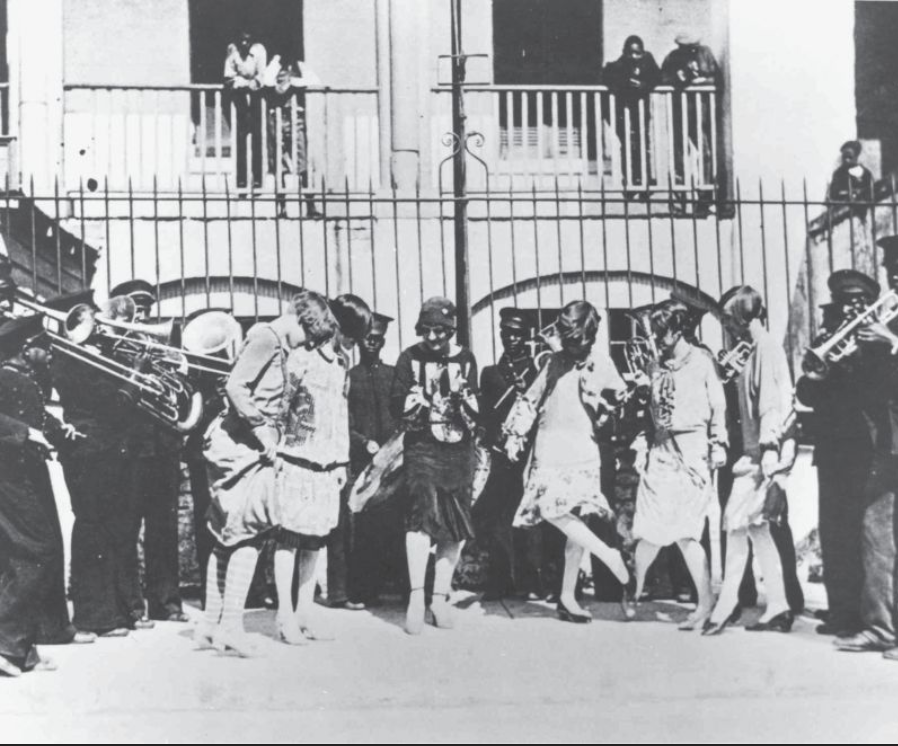
We can only collect as many stories and memories as we can to build a more complete picture of how the history of the Charleston dance. What we know now is that the Charleston dance swept the world up in a frenzy of wild dancing.
Here is a excerpt from the Jenkins Orphanage Band performing. You can see the boy doing the early Charleston, “geechie” dance. You can watch the full video here.
1920s — Charleston on Stage and Film
The Charleston became a national craze in the early 1920s, officially debuting in the all-Black Broadway show Runnin’ Wild (1923), danced to James P. Johnson’s The Charleston.
In 1925, Josephine Baker introduced it to Europe during her Parisian tour La Revue Nègre, igniting an international frenzy.
By 1928, Joan Crawford famously danced it in Our Dancing Daughters, cementing its image as the dance of the Jazz Age.
Why is Solo Charleston Still Popular Today?
- Freedom of Expression – You interpret the music entirely your way.
- Musical Precision – The dance trains syncopation and rhythmic control.
- Performance Impact – Big shapes and playful character are perfect for stage and social floors.
- Historical Connection – Dancing Charleston connects you to both jazz culture’s African American roots and the flapper-era rebellion of the 1920s.
How to Dance Solo Charleston: The Basic Step
Here you can find my most popular video with over a million views on how to do basic Charleston
Conclusion
As Cholly Atkins wrote in Class Act:
“We think it came up from South Carolina with its name intact and was introduced in a Broadway show, Runnin’ Wild… There was so much cross-fertilisation — from the street, to the theatre, to the dance hall, to the nightclub.”
The Charleston dance, like many authentic jazz forms, is rooted in African tradition. It evolved depending on who performed it, where it was danced, and how it was staged.
Sadly, little to no documentation exists of Black Charleston dancers from its earliest days — whether lost, destroyed, or deliberately erased. What remains is a puzzle of stories, memories, and recordings.
For me, this dance is at the heart of everything we do in Lindy Hop and solo jazz. Understanding its roots only deepens its beauty. I aim to honour it in my teaching and my course Secrets of Charleston 20s, where you can explore its steps, variations, and history.
As Cholly Atkins wrote in Class Act:
“We think it came up from South Carolina with its name intact and was introduced in a Broadway show, Runnin’ Wild… There was so much cross-fertilisation — from the street, to the theatre, to the dance hall, to the nightclub.”
The Charleston dance, like many authentic jazz forms, is rooted in African tradition. It evolved depending on who performed it, where it was danced, and how it was staged.
Sadly, very little documentation exists of Black Charleston dancers from its earliest days — whether lost, destroyed, or deliberately erased. What remains is a puzzle of stories, memories, and recordings.
For me, this dance is at the heart of everything we do in Lindy Hop and solo jazz. Understanding its roots only deepens its beauty. I aim to honour it in my teaching and my course Secrets of Charleston 20s, where you can explore its steps, variations, and history. You can check the subscription plan here.
Curious to dive deeper into Charleston dance history, explore the differences between 1920s and 1930s styles, learn the steps, discover styling tips, and meet today’s “modern flappers”? Check out these blogs:
- Secrets of Charleston 20s: how to dance
- 5 best Charleston dance videos by Ksenia
- how to do the charleston
If you want to go beyond reading about the Charleston and actually dance it, I teach a complete Secrets of Charleston 20s course inside my online school. You’ll learn the fundamental steps, authentic variations, and playful styling that bring this jazz-era dance to life — along with tips on musicality, posture, and performance. You can explore the full course here:
Resources
Frankie Manning: Ambassador of Lindy Hop by Frankie Manning, Cynthia R. Millman
The Wicked Waltz and Other Scandalous Dances by Mark Knowles
Black Dance in the United States from 1916 to 1970 by Emery, Lynne Fauley
A Gullah Guide to Charleston: Walking Through Black History by Alphonso Brown
The Cradle of JAZZ. Reverend Daniel Jenkins and his orphanage band
Jenkins Orphanage Band gave African American boys another chance at life
“Jenkins Orphanage ” by Julie Hubbert
The Gullah Gechee people
The Gullah: Rice, Slavery, and the Sierra Leone-American Connection